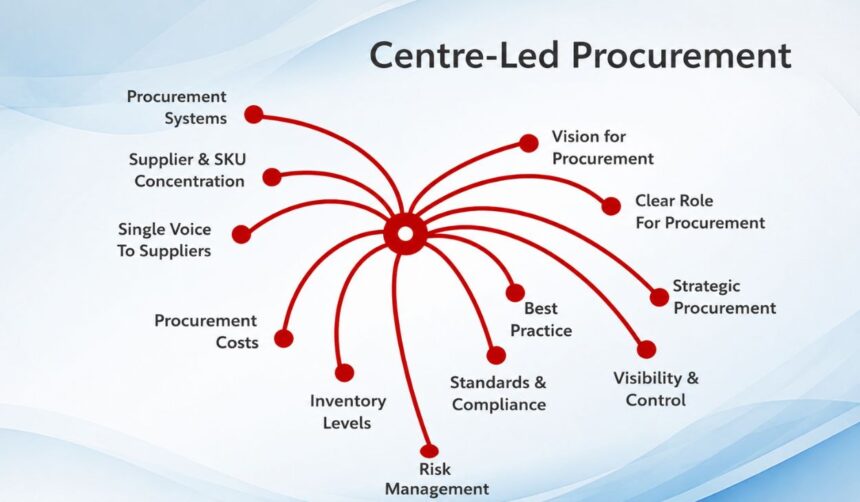
Center led procurement is a flexible purchasing model that combines the strengths of centralized strategy with the practical knowledge of local teams. Instead of requiring every purchasing decision to pass through one central department, organizations coordinate important strategies, supplier relationships, standards, and policies while allowing business units to manage suitable day-to-day requirements. This approach works especially well for companies with multiple departments, locations, or markets that have different purchasing needs. The main idea is simple: strategic direction comes from the center, while execution can remain close to the people who understand the business best.
How Center Led Procurement Works
A successful center led procurement structure clearly divides responsibilities between central procurement professionals and local teams. The central function may manage category strategies, major supplier negotiations, contracts, procurement technology, risk policies, and performance standards, while local employees handle operational purchases within approved guidelines. This strategy stops several departments from making separate supplier agreements or continually negotiating comparable deals. At the same time, local teams do not feel completely disconnected from purchasing decisions because they retain the flexibility needed to respond to specific operational requirements.
Center-Led vs. Centralized Procurement
Center-led procurement and centralized procurement may sound similar, but they are not exactly the same. In a centralized model, most purchasing authority and activity is concentrated within one procurement organization, whereas a center-led model distributes certain responsibilities between central and local teams. Centralization can provide strong control and standardization, but it may become less practical when organizations operate across different regions with unique regulations, suppliers, and business conditions. Center-led procurement provides a middle path by combining enterprise-wide coordination with enough local freedom to keep purchasing responsive and practical.
Center-Led vs. Decentralized Procurement
A decentralized procurement model gives individual departments or business units considerable freedom to select suppliers, negotiate prices, and make purchasing decisions. Although this can make local operations faster, it can also create duplicated suppliers, inconsistent contracts, different pricing, and limited visibility into overall organizational spending. Center led procurement addresses these weaknesses by bringing strategic activities together while keeping appropriate purchasing responsibilities within local teams. This creates a more balanced structure in which the organization can use its combined purchasing power without ignoring the knowledge and requirements of individual departments.
Why Businesses Are Adopting Center Led Procurement
Businesses are increasingly looking at center led procurement because procurement has developed far beyond simply ordering products and services. Modern procurement teams are expected to contribute to cost management, supplier performance, risk reduction, resilience, innovation, and overall business growth. A fragmented purchasing structure can make these goals difficult because important information may be spread across different departments and systems. A center-led approach creates greater coordination while allowing procurement professionals to focus on strategic opportunities instead of spending all their time processing routine transactions.
Balancing Central Control with Local Flexibility
One of the biggest advantages of center led procurement is its ability to balance central control with local flexibility. A large organization may benefit from negotiating a single enterprise contract for software, transportation, or professional services, but different regions may still need suppliers or solutions that meet local requirements. A center-led model can establish common standards while permitting reasonable exceptions where local conditions genuinely require them. When these boundaries are clearly defined, employees understand which decisions are controlled centrally and where they have freedom to act, reducing both unnecessary bureaucracy and uncontrolled purchasing.
Strategic Category Management
Strategic category management is an important part of a strong center-led procurement structure because it encourages organizations to look at complete spending categories rather than individual transactions. Instead of focusing only on getting the lowest possible price, procurement professionals can evaluate supplier markets, demand patterns, quality, contract terms, supply risks, and total ownership costs. Central category managers can identify opportunities across several business units that may be invisible when departments purchase independently. This broader perspective helps organizations negotiate more effectively while also improving specifications, supplier choices, and long-term purchasing strategies.
Supplier Relationship Management
Strong supplier relationships can have a major effect on procurement performance, particularly when suppliers provide essential products or services. A center-led model allows organizations to develop a more complete view of important suppliers by combining information from different departments and locations. Central teams can establish supplier performance standards, risk assessments, and review processes, while local teams can provide valuable feedback about everyday service and delivery. Instead of contacting suppliers only when something goes wrong, procurement can build longer-term relationships focused on quality, reliability, innovation, improvement, and business continuity.
Technology and Data in Center Led Procurement
Technology provides the foundation needed to make center led procurement effective across a large organization. Central teams need accurate information about suppliers, contracts, purchase orders, invoices, spending patterns, and business-unit requirements to make informed decisions. A more comprehensive view of the whole purchasing process may be obtained by connecting sourcing, contracts, purchasing, supplier management, and analytics using digital procurement systems. Automation can also reduce repetitive work, allowing procurement professionals to spend more time on negotiation, category strategy, supplier development, and other activities that require human judgment.
Benefits of Center Led Procurement
The benefits of center led procurement can extend well beyond simple cost savings. Organizations can improve spend visibility, strengthen supplier negotiations, reduce duplicate purchasing, establish consistent standards, and develop specialized procurement expertise that individual departments may not be able to maintain on their own. The model can also improve risk management because central teams can identify supplier concentration, contract exposure, and other problems across the entire organization. When supported by appropriate technology and governance, procurement can become a strategic business partner rather than a function focused mainly on processing purchase requests.
Improving Cost Savings and Spend Visibility
Cost savings are often an important reason organizations consider a center-led model, but visibility into spending may be even more valuable. When departments buy independently, similar products or services can be purchased at different prices and under completely different contract terms. Bringing spending information together makes it easier to identify duplicated suppliers, negotiate volume-based agreements, and determine where purchasing practices can be improved. A mature procurement function also looks beyond purchase price by considering quality, transportation, maintenance, supplier reliability, administrative effort, and other factors that influence the true cost of a purchasing decision.
Strengthening Supplier Risk Management
Supplier risk has become increasingly important as businesses face supply disruptions, changing markets, geopolitical uncertainty, and unexpected operational challenges. A center-led procurement structure gives organizations a central point for collecting and analyzing information about critical suppliers while allowing local teams to contribute practical knowledge. Procurement can then identify important dependencies, monitor supplier performance, evaluate alternatives, and develop contingency strategies before problems become serious. The goal is not to remove every possible risk, because that would be unrealistic, but to understand major exposures and make informed decisions about how those risks should be managed.
Building Better Stakeholder Relationships
Even the best procurement strategy can fail if employees see procurement as an unnecessary obstacle. For center led procurement to succeed, central procurement teams need to build genuine relationships with finance, operations, IT, marketing, engineering, sales, and local management. These stakeholders understand the practical side of the business, so their input can help procurement create strategies that are realistic rather than overly restrictive. When employees understand why preferred suppliers, purchasing policies, and approval processes exist, they are more likely to follow them and view procurement as a helpful partner instead of simply another layer of administration.
Common Challenges and Implementation Risks
Moving toward a center-led procurement structure can create challenges, particularly in organizations where departments have traditionally controlled their own purchasing. Local teams may worry that central procurement will reduce their independence, slow down urgent decisions, or fail to understand local market conditions. Poor data quality, unclear responsibilities, inconsistent processes, and weak communication can create additional problems during implementation. These challenges can be managed through clear decision rights, practical exception procedures, employee training, strong leadership support, and gradual implementation that demonstrate measurable value before expanding the model across the organization.
How to Implement a Center Led Procurement Model
Organizations should begin implementation by examining current spending, suppliers, contracts, procurement responsibilities, technologies, and stakeholder expectations. The next step is to determine which activities should be coordinated centrally and which should remain within local teams based on factors such as business impact, complexity, risk, and the value of scale. Clear responsibilities should then be documented so employees know who manages category strategy, supplier selection, contracting, purchasing, and exceptions. Starting with selected high-value categories can help organizations test the model, demonstrate results, learn from employees, and gradually expand the approach.
Governance, KPIs, and Continuous Improvement
Good governance provides the structure that keeps a center-led procurement model consistent without making it unnecessarily rigid. Organizations should establish clear policies, approval thresholds, contract requirements, supplier standards, exception processes, and performance responsibilities. Key performance indicators can measure areas such as savings, spend visibility, contract compliance, supplier performance, purchasing efficiency, stakeholder satisfaction, and risk exposure. Continuous improvement is equally important because procurement needs to evolve as business requirements change, and recurring exceptions or employee feedback can reveal where processes, policies, or technology should be improved.
The Future of Center Led Procurement
The future of center led procurement will likely be shaped by automation, artificial intelligence, advanced analytics, digital supplier management, and stronger strategic collaboration. Routine purchasing activities can increasingly be handled through self-service systems, giving procurement professionals more time to focus on negotiations, supplier relationships, category planning, risk management, and business strategy. At the same time, local teams can become more empowered because digital tools can give them faster access to approved suppliers, contracts, purchasing channels, and useful information. The most successful organizations will likely treat procurement as a connected ecosystem in which technology supports people and decisions are made at the level where they create the greatest value.
Conclusion
Center led procurement provides a practical balance between centralized control and decentralized flexibility, making it a useful approach for organizations that want stronger coordination without creating unnecessary restrictions. By combining central expertise, shared data, strategic category management, supplier governance, and local business knowledge, companies can improve both purchasing performance and operational responsiveness. The model is not simply about deciding who has purchasing authority; it is about creating a smarter system in which the right people make the right decisions with reliable information. When supported by clear governance, strong technology, capable professionals, and effective communication, center-led procurement can help organizations reduce waste, manage suppliers more effectively, improve resilience, and create lasting business value.
FAQs About Center Led Procurement
- What is center led procurement?
Center led procurement is a purchasing model that combines centralized procurement strategy with local purchasing flexibility. A central team manages areas such as supplier strategy, category management, contracts, governance, and procurement standards, while local teams handle suitable operational purchasing decisions.
- How does center led procurement differ from centralized procurement?
Centralized procurement places most purchasing authority within one central department, while center led procurement distributes selected responsibilities between central and local teams. This allows organizations to gain the benefits of centralized expertise and purchasing power without removing necessary local flexibility.
- What are the main benefits of center led procurement?
The main benefits include improved spend visibility, stronger supplier negotiations, better risk management, reduced purchasing duplication, consistent procurement policies, and greater access to specialized expertise. It can also help organizations balance cost efficiency with local business requirements.
- What challenges can affect center led procurement?
Common challenges include resistance from local teams, unclear responsibilities, poor procurement data, inconsistent processes, technology limitations, and concerns about excessive central control. Clear governance, communication, training, and well-defined decision-making responsibilities can help address these challenges.
- How can a company implement center led procurement successfully?
A company can begin by analyzing its current spending, suppliers, contracts, processes, and procurement responsibilities. It should then define which activities belong to the central team and which should remain local, establish clear governance, and introduce suitable technology, train employees, and measure results through meaningful procurement KPIs.